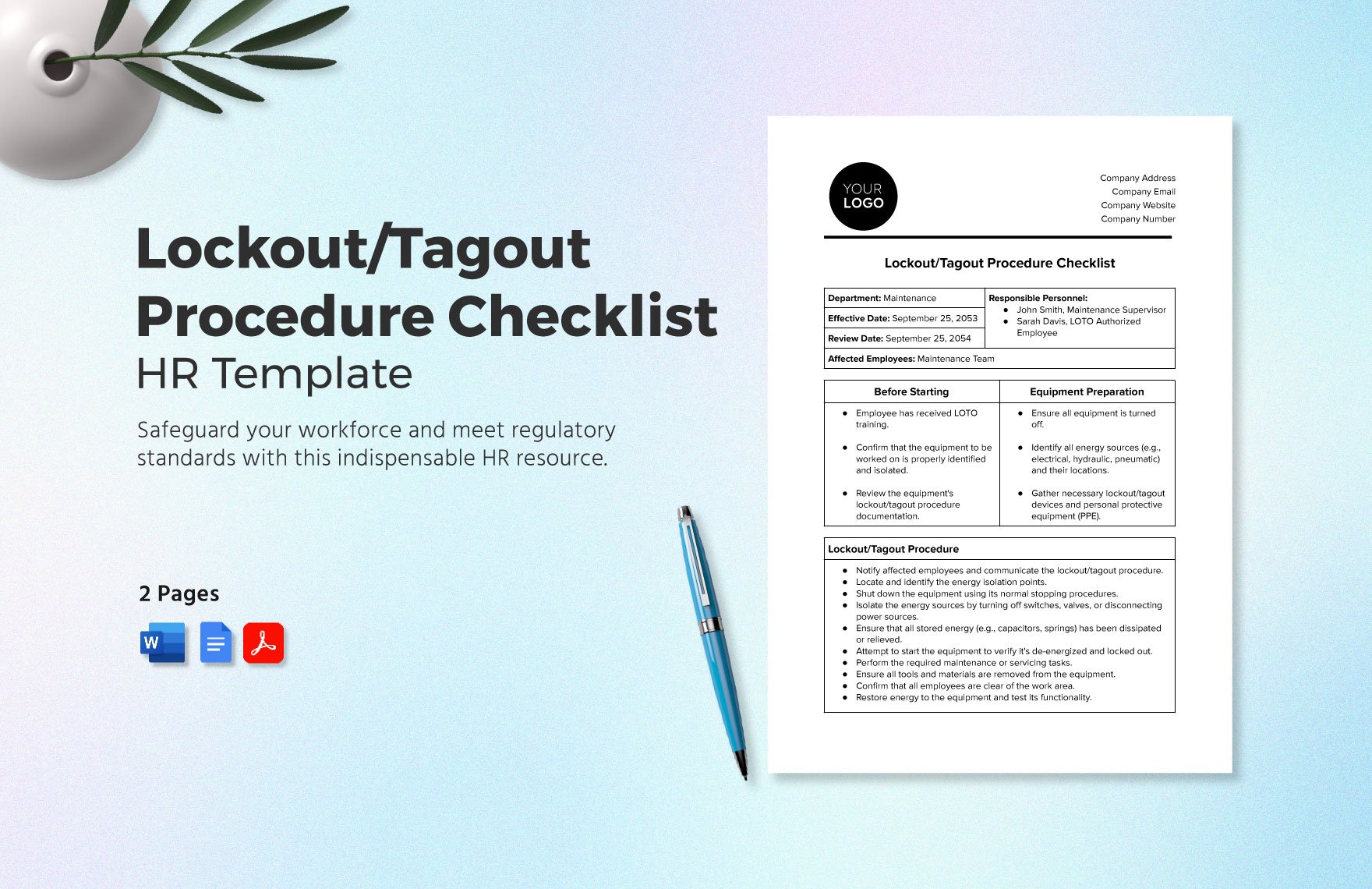
Every year, preventable accidents occur when machinery is accidentally energized during maintenance. The root cause? A missing or poorly executed lockout tagout (LOTO) procedure. A standardized lockout tagout safety PDF isn’t just paperwork—it’s a frontline defense against electrocution, crushing injuries, and fatalities. Whether you’re managing a manufacturing floor, a maintenance team, or a facility with complex machinery, having a clear, accessible LOTO safety PDF is non-negotiable.
This guide breaks down what makes an effective LOTO safety PDF, how to use it correctly, and where to source or create templates that meet regulatory standards and real-world demands.
What Is a Lockout Tagout Safety PDF and Why It Matters
A lockout tagout safety PDF is a digital document that outlines the procedures, responsibilities, and steps required to safely de-energize machinery before servicing. It serves as both a training tool and a reference during lockout operations. Unlike paper binders that can fade or go missing, a well-structured PDF is easily distributable, printable, and updatable.
These documents typically include: - Equipment-specific energy sources - Step-by-step shutdown and isolation procedures - Authorized personnel roles - Required lockout devices - Verification steps
OSHA standard 29 CFR 1910.147 mandates that every energy-controlled procedure must be documented. A PDF version ensures consistency across shifts, locations, and training sessions.
Example: A maintenance technician at a food processing plant prepares to unclog a conveyor belt. Without referencing the LOTO safety PDF, they might miss isolating a secondary pneumatic line. That oversight could lead to sudden movement—resulting in a crushed hand. With the PDF, each energy source is methodically identified and locked out.
Core Components of an Effective LOTO Safety PDF
Not all lockout tagout PDFs are created equal. A checklist buried in a 50-page manual won’t help during a time-sensitive repair. Your LOTO safety PDF must be: - Clear: Plain language, no jargon - Visual: Diagrams of lock points, flowcharts - Equipment-specific: Not generic templates - Action-oriented: Uses imperative verbs like “shut off,” “verify,” “lock”
Include these key sections in every LOTO safety PDF:
1. Equipment Identification List the machine name, model, location, and unique ID. This prevents confusion when multiple similar units exist.
2. Energy Source Inventory Detail every energy type involved:
- Electrical (voltage levels)
- Hydraulic (fluid pressure)
- Pneumatic (air lines)
- Mechanical (springs, gravity)
- Chemical or thermal sources
3. Step-by-Step Procedure Break
this into phases:
- Preparation: Notify affected employees, gather locks/tags
- Shutdown: Normal stop procedure
- Isolation: Disconnect all energy sources
- Lockout Application: Attach personal lock and tag
- Stored Energy Dissipation: Bleed lines, block parts, vent pressure
- Verification: Attempt startup (with controls) to confirm zero energy
4. Clear Roles and Signatures Define who is authorized (usually trained maintenance staff) versus affected employees (those who operate but don’t service). Include sign-off sections for procedure completion.
5. Emergency Exceptions Clarify what to do if a lock must be removed by someone other than the installer (e.g., supervisor override with documented justification).
Common Mistakes That Undermine LOTO Safety PDFs

Even with a PDF in hand, teams make critical errors that compromise safety:
Using Generic Templates A one-size-fits-all PDF for all machinery ignores unique energy configurations. A CNC machine has different risks than a hydraulic press. Customization is mandatory.
Real Case: A plant used the same LOTO PDF for multiple punch presses. One unit had a secondary hydraulic accumulator not listed. During servicing, it discharged—causing a fatal crush injury. Root cause: inadequate documentation.
Failing to Update After Equipment Changes Machines get retrofitted. A new control panel might introduce unexpected electrical feeds. If the LOTO PDF isn’t revised, it becomes a liability.
Poor Accessibility Storing the PDF on a restricted server or outdated intranet means technicians can’t access it during maintenance. Best practice: host offline copies on tablets or print laminated versions near equipment.
Skipping the Verification Step
Many workers lock out but never verify. The LOTO safety PDF must emphasize: “Test the controls. Confirm zero energy.” Without proof, the lock is just decoration.
How to Create a Compliant LOTO Safety PDF (Step-by-Step)
Creating your own LOTO safety PDF ensures it matches your operations. Follow this workflow:
Step 1: Conduct an Energy Audit Walk through each machine with maintenance and safety leads. Map every energy input and residual energy point. Use a camera to document lock locations.
Step 2: Draft the Procedure Use bullet points, not paragraphs. Keep each action discrete. Example: > 1. Shut off main power at the control panel. > 2. Close valve V-12 on the hydraulic supply line. > 3. Attach personal lock to circuit breaker CB-7. > 4. Open drain valve D-3 to release line pressure. > 5. Verify zero energy by attempting to start the machine.
Step 3: Add Visual Aids Insert labeled diagrams showing:
- Lock placement points
- Energy isolation valves
- Tag locations
Even a simple sketch improves comprehension.
Step 4: Review and Approve Have safety officers, supervisors, and a maintenance tech review the draft. Does it work in practice? Revise based on feedback.
Step 5: Distribute and Train Convert to PDF. Share via email, intranet, and printed stations. Conduct hands-on training using the document.
Where to Find Reliable Lockout Tagout Safety PDF Templates
You don’t always need to build from scratch. Reputable sources offer editable LOTO safety PDFs that meet OSHA standards.
Here are five trusted options:
| Name | Source | Features | Best For |
|---|---|---|---|
| OSHA 1910.147 Compliance Guide | U.S. Department of Labor | Official standard text, checklists | Regulatory reference |
| Free LOTO Procedure Template | Creative Safety Supply | Editable PDF, equipment-specific fields | Quick implementation |
| Lockout/Tagout Authorized Employee Training | OSHAcademy | Training-ready PDF with quizzes | Onboarding teams |
| Sample LOTO Program PDF | NFPA | Full program outline, policy framework | EHS managers |
| Machine-Specific LOTO Templates | SafetySkills | Industry-specific (e.g., food processing, HVAC) | Niche applications |
While templates save time, always customize. Insert your site’s equipment names, lock types, and emergency contacts.
Integrating LOTO Safety PDFs Into Daily Operations
A PDF that sits in a folder does nothing. Integration is key.
Use in Training During onboarding, walk new technicians through the LOTO PDF for their primary equipment. Have them follow it during a mock service—no actual disassembly needed.

Pre-Job Briefings Before any maintenance, supervisors should pull up the LOTO safety PDF and review steps with the team. This reinforces accountability.
Digital Accessibility Load LOTO PDFs onto mobile devices used by maintenance crews. Use QR codes near machines that link directly to the correct PDF.
Audit Tool During safety audits, ask: “Can you show me the LOTO PDF for this machine?” Then verify compliance step-by-step.
Limitations of Relying Solely on a PDF
A digital document is powerful but not foolproof.
- No Substitute for Training: A worker might read the PDF but not understand lock types or bleed procedures. Hands-on drills are essential.
- Static by Nature: PDFs don’t update automatically. A change in machinery requires manual revision.
- No Enforcement Mechanism: The PDF can’t stop someone from bypassing steps. Culture and supervision fill that gap.
Think of the LOTO safety PDF as the playbook—not the player.
Real-World Use Case: Reducing Downtime in an Automotive Plant
At a Midwest auto parts facility, unplanned incidents during maintenance caused 18 hours of downtime monthly. After auditing their LOTO process, they discovered inconsistent documentation—some machines had no PDF, others used outdated versions.
They implemented a standardized LOTO safety PDF system: - Created machine-specific PDFs with photos and QR codes - Trained 47 technicians using the documents - Stored PDFs on rugged tablets in maintenance carts
Result: Zero LOTO-related incidents in 14 months. Downtime dropped to 4 hours per month. The PDFs didn’t just improve safety—they boosted operational efficiency.
Final Thoughts: Make Your LOTO Safety PDF a Living Document
A lockout tagout safety PDF should never be “done.” Revisit it: - Annually, as part of compliance reviews - After any incident or near-miss - When equipment is modified or replaced - When new staff identify confusion points
Update, redistribute, and retrain. A current, clear, and accessible PDF protects lives and keeps your operation running smoothly.
Download, customize, and implement a LOTO safety PDF today—before the next accident reminds you it’s necessary.
What is the purpose of a lockout tagout safety PDF? It documents energy control procedures to prevent accidental machine startup during maintenance, ensuring worker safety and regulatory compliance.
Can I use a generic LOTO safety PDF for all machines? No. Each machine has unique energy sources and isolation points. Use equipment-specific PDFs for accurate, safe procedures.
Who should have access to the LOTO safety PDF? Authorized employees (maintenance staff) must have immediate access. Affected employees should be trained on its existence and purpose.
How often should a LOTO safety PDF be updated? Review at least annually, or whenever equipment changes, incidents occur, or procedures are found lacking.
Are electronic LOTO safety PDFs OSHA-compliant? Yes, if they are accessible, legible, and available to workers during servicing. Offline access is recommended.
Do I need a separate PDF for each machine? Yes, best practice is one detailed PDF per machine or equipment type to ensure precision and safety.
Can a LOTO safety PDF replace employee training? No. The PDF supports training but cannot replace hands-on instruction, verification drills, and supervisor oversight.
FAQ
What should you look for in Lockout Tagout Safety PDF Guide for Workplace Compliance? Focus on relevance, practical value, and how well the solution matches real user intent.
Is Lockout Tagout Safety PDF Guide for Workplace Compliance suitable for beginners? That depends on the workflow, but a clear step-by-step approach usually makes it easier to start.
How do you compare options around Lockout Tagout Safety PDF Guide for Workplace Compliance? Compare features, trust signals, limitations, pricing, and ease of implementation.
What mistakes should you avoid? Avoid generic choices, weak validation, and decisions based only on marketing claims.
What is the next best step? Shortlist the most relevant options, validate them quickly, and refine from real-world results.